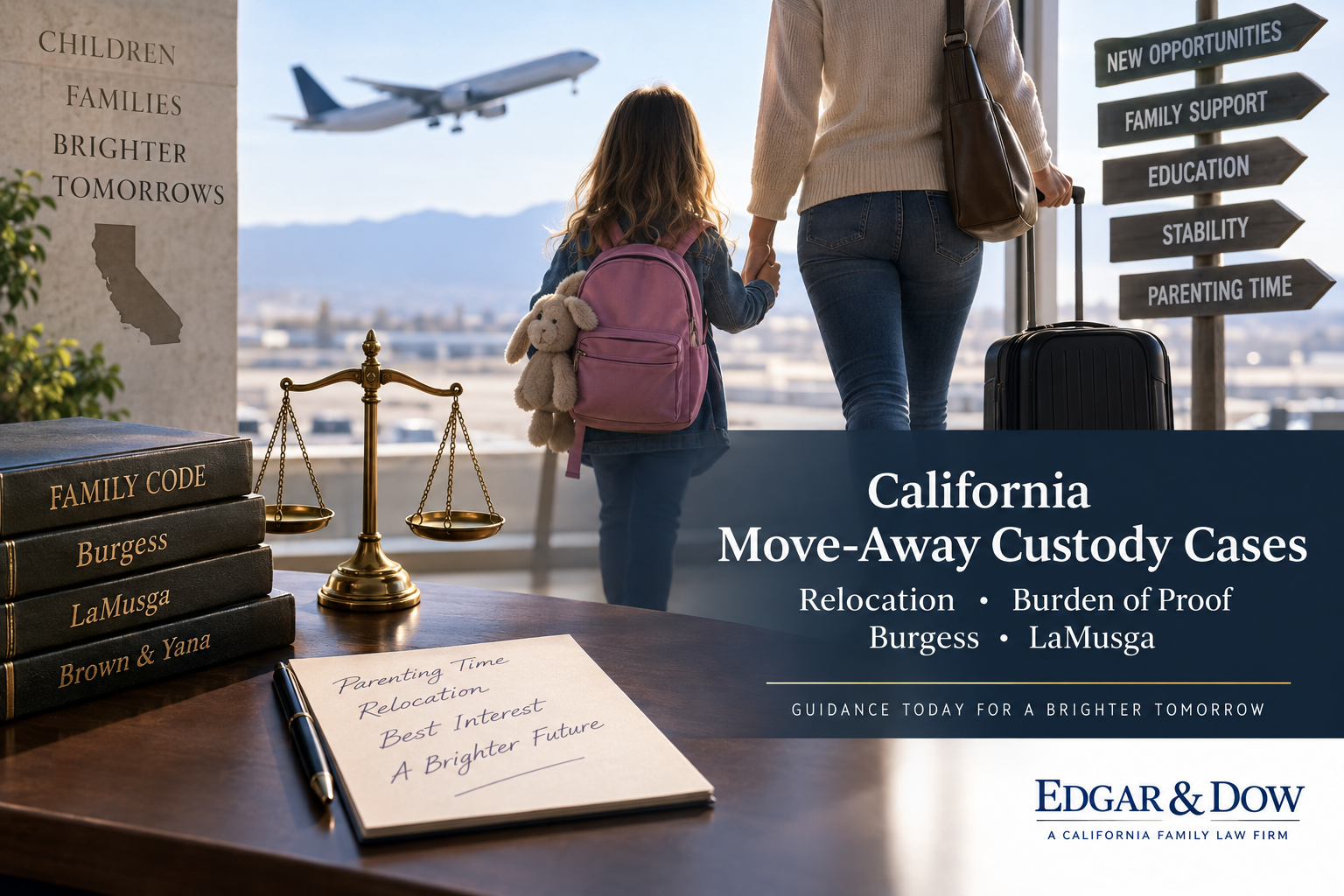
Move-away cases are some of the most difficult child custody cases we handle in California family court. One parent wants to relocate with the child, sometimes hundreds or thousands of miles away, and the other parent is faced with the prospect of losing regular day-to-day contact.
After nearly three decades practicing family law, the first question I ask when evaluating a move-away case is not:
“Why do you want to move?”
It is:
“What is the existing timeshare?”
That question can determine the legal framework and burden of proof for the entire case.
California move-away cases generally begin on one of two tracks. If the parents genuinely share physical custody, the court may make a de novo determination of what custody arrangement will be in the child’s best interest after the move. If one parent is the established primary custodial parent under a final custody order, that parent may have a presumptive right to relocate, and the burden generally shifts to the parent opposing the move to demonstrate detriment to the child.
Understanding which case you have is the starting point.
Parents sometimes believe the most important issue is the reason for the move: a new job, remarriage, family support, housing costs or a better opportunity somewhere else.
Those issues can matter. But they are generally not where I begin my analysis.
I want to see the custody orders and the actual parenting schedule.
How many overnights does each parent have? What has actually occurred in practice? Is this genuinely a shared custodial arrangement, or does one parent have primary physical custody while the other parent exercises visitation?
The distinction matters because California applies different move-away standards depending upon the existing custody arrangement.
In re Marriage of Burgess is the starting point for modern California move-away law.
One of the most important parts of Burgess for practicing family law attorneys is footnote 12.
When parents genuinely share physical custody and one parent intends to relocate, the existing custody arrangement necessarily has to change. A true shared arrangement generally cannot continue when the parents suddenly live hundreds or thousands of miles apart.
In that situation, the court makes a de novo determination of what post-move custody arrangement will be in the child’s best interest.
This is fundamentally different from a case involving an established primary custodial parent.
In practical terms, neither parent receives the same advantage that an established primary custodial parent may have in a traditional Burgess move-away case. The court must determine which parent should have primary physical custody after the relocation.
That is why the timeshare is one of the first things we analyze.
A custody order may say “joint physical custody.” That does not necessarily end the analysis.
California move-away law looks at whether the parents actually have a genuine shared physical custody arrangement.
I have seen plenty of custody orders that use the words “joint physical custody” while one parent actually has the child the substantial majority of the time. Conversely, the parties may have developed an actual shared parenting arrangement that differs from the language of an older order.
For move-away purposes, the substance of the arrangement can matter more than the label.
We therefore look at the actual schedule, the number of overnights, the history of the parenting arrangement and how responsibility for the child has really been divided.
This can determine whether the case proceeds under the Burgess footnote 12 de novo analysis or under the traditional primary-custodian move-away framework.
When there is a qualifying final custody determination and one parent has primary or sole physical custody rather than a genuine shared arrangement, California law starts from a different position.
Family Code section 7501 recognizes a custodial parent’s presumptive right to change the child’s residence, subject to the court’s authority to intervene when the relocation would prejudice the child’s rights or welfare.
That does not mean the custodial parent automatically wins.
It means the burden starts on the other side.
The nonmoving parent generally has the initial burden of demonstrating that the proposed relocation would cause detriment to the child sufficient to justify reconsideration of the existing custody arrangement.
That distinction can be outcome-determinative.
The answer depends substantially upon the existing custody arrangement.
If the parents genuinely share physical custody, Burgess footnote 12 generally calls for a de novo determination of what custody arrangement will be in the child’s best interest after the move.
If one parent has primary physical custody under a qualifying final custody order and the arrangement is not genuine shared physical custody, the custodial parent generally has a presumptive right to relocate. The nonmoving parent then bears the initial burden of demonstrating detriment to the child.
This is why I do not begin a move-away consultation by simply asking whether the move is a good idea.
First, we determine the timeshare.
Then we determine the legal standard.
Then we determine the burden of proof.
Only after that do we start developing the evidence.
Detriment means more than the fact that the parent remaining behind will see the child less frequently.
That consequence exists in almost every substantial move-away case.
The issue is detriment to the child.
For example, the court may examine the nature and strength of the child’s relationship with the nonmoving parent, the effect of substantially reducing that contact, the child’s age and particular needs, school and community ties, the distance of the move, the feasibility of maintaining a meaningful relationship with both parents and the parents’ history of supporting or interfering with the child’s relationship with the other parent.
A parent opposing relocation needs to explain specifically how this particular child will be harmed by this particular move.
General objections are not the same thing as evidence of detriment.
In re Marriage of Brown & Yana is particularly important for a parent opposing relocation.
Brown & Yana makes clear that a noncustodial parent must make a meaningful threshold showing of detriment. It is not enough simply to say that the parent objects to the move or wants the existing schedule to continue.
The claimed detriment needs to be connected to the child and the actual relocation plan.
Brown & Yana also addressed whether the opposing parent was entitled to a full evidentiary hearing. The California Supreme Court concluded under the procedure then applicable that a full evidentiary hearing was not automatically required without a sufficient prima facie showing of detriment.
There is an important procedural qualification today. Brown & Yana predates Family Code section 217, which generally requires relevant and competent live testimony at Family Code motion hearings unless the parties stipulate otherwise or the court finds good cause not to receive it.
The continuing practical lesson from Brown & Yana is nevertheless important: the parent opposing a move should be prepared from the beginning to identify specific evidence of detriment rather than simply objecting to relocation.
Once the case reaches the broader best-interest determination, In re Marriage of LaMusga becomes particularly important.
LaMusga identifies a number of considerations that courts may examine in determining whether relocation would be detrimental and whether custody should be modified.
These include the child’s interest in stability and continuity, the distance of the move, the child’s age, the child’s relationship with both parents, the parents’ ability to communicate and cooperate, the child’s wishes when the child is sufficiently mature, the reasons for the proposed move and the extent to which the parents currently share custody.
This is where move-away cases become extremely fact-specific.
There is no mathematical formula that tells the judge what to do.
Two cases involving parents moving the same distance can have completely different results because the children, parenting histories and relationships are different.
California courts place significant importance on maintaining stability and continuity for children.
But stability does not automatically mean keeping the child with the existing primary custodial parent.
LaMusga itself is an important example. The mother had been the children’s primary physical custodian, yet the court ordered that physical custody would transfer to the father if she relocated. A significant concern involved the effect of the move on the children’s relationship with their father and the evidence concerning whether the mother would foster that relationship after relocating.
That is a practical lesson I emphasize in move-away cases.
A parent’s historical willingness—or unwillingness—to support the child’s relationship with the other parent can become extremely important.
Move-away cases frequently overlap with restrictive gatekeeping issues.
If a parent already limits telephone calls, interferes with exchanges, schedules activities during the other parent’s time, makes communication unnecessarily difficult or otherwise demonstrates resistance to the child’s relationship with the other parent, the court may reasonably ask what will happen when the parents live 500 or 1,500 miles apart.
Distance magnifies existing problems.
On the other hand, a parent who has consistently supported the child’s relationship with the other parent is in a much stronger position to explain how that relationship will continue after relocation.
Past conduct often tells the court something about what is likely to happen in the future.
No.
This is another common misconception.
California law generally does not require the custodial parent to prove that the move is “necessary.”
The court is not ordinarily supposed to substitute its own judgment about whether the parent should accept a particular job, remarry, move closer to relatives or choose to live somewhere else.
But the reasons for the move are not completely irrelevant.
If there is evidence that the move is intended to frustrate the child’s relationship with the other parent, that can become an important factor in determining the child’s best interest.
The distinction is important.
The parent does not have to prove that moving is necessary. But motivation, credibility and the effect of the move on the child can still matter.
Generally, the custody case is about where the child will live—not whether an adult parent is allowed to move.
The court ordinarily analyzes the case on the assumption that the parent proposing relocation actually intends to move.
That means the real question becomes:
“If this parent moves, what custody arrangement is in the child’s best interest?”
In a genuine shared-custody case, that question is particularly important because the existing parenting arrangement will no longer be possible.
The court should not decide the case based on an assumption that denying the request will force the parent to remain where they are.
Not every relocation presents the same problem.
Moving from Riverside to Temecula is very different from moving from Riverside to Texas, Florida or another country.
As distance increases, the existing parenting schedule may become impossible.
Alternating weekends may no longer make sense. Midweek parenting time may disappear. Airfare and travel time become significant. School calendars, summer vacation and holidays become increasingly important.
The court therefore needs to see a realistic post-move parenting plan.
One mistake moving parents make is focusing entirely on why the new location will be better.
A new job, larger home, better schools or nearby grandparents may all be relevant. But the court also needs to understand how the child’s relationship with the other parent will be preserved.
A serious move-away proposal should address transportation, travel expenses, holidays, summer parenting time, school breaks, telephone or video contact and how important events in the child’s life will be handled.
A parent who simply says, “We will figure it out,” is leaving an important part of the case unanswered.
A thoughtful parenting proposal demonstrates that the moving parent has considered not only the advantages of relocation, but also what the child will lose and how that loss can be reduced.
Riverside and San Bernardino are recommending counties.
That makes Child Custody Recommending Counseling particularly important in move-away litigation.
The CCRC counselor may make a recommendation directly to the judge. In my experience, those recommendations can carry substantial weight.
That is one reason our office spends considerable time preparing clients for CCRC.
Parents sometimes go into mediation focused almost entirely on the other parent: the other parent’s new spouse, significant other, family, personality or events that may have little relevance to the actual custody determination.
That can be a mistake.
In a move-away case, the important issues are much more likely to involve the child’s existing relationships, the actual timeshare, stability, the effect of relocation and whether there is a realistic plan for maintaining the child’s relationship with both parents.
Preparation matters.
Move-away cases frequently lend themselves to a focused Family Code section 3111 custody evaluation.
I sometimes refer to the section 3111 evaluation as the “little brother” of a full Evidence Code section 730 evaluation.
A section 3111 evaluation can provide the court with professional analysis of the specific custody issues involved in the proposed relocation without necessarily requiring the broader scope of a full 730 evaluation.
The evaluator may consider the child’s relationship with each parent, the existing timeshare, the child’s school and community adjustment, the practical effects of relocation and the proposed parenting plans.
In a close move-away case, that evaluation can become extremely important.
Parents should carefully review their existing custody orders before making relocation plans.
Family Code section 3024 permits the court to include an order requiring notice when a parent plans to change the child’s residence for more than 30 days.
Where that requirement applies, notice should, when feasible, be provided at least 45 days before the proposed change of residence so the parents have time to mediate or litigate a new custody arrangement.
The important practical point is simple:
Do not wait until the moving truck is packed.
Move-away litigation takes time, particularly when CCRC or a custody evaluation will be required.
Preparation should begin well before the hearing.
The moving parent should be prepared to explain the proposed residence, school, childcare arrangements, employment, family support, transportation and the proposed long-distance parenting schedule.
But just as importantly, that parent needs to demonstrate an understanding of the child’s relationship with the parent who will remain behind.
The strongest presentation is generally not:
“This move is better for me.”
It is:
“Here is how this move will affect our child, and here is the realistic plan I am proposing to address those consequences.”
The parent opposing relocation should focus on detriment to the child rather than unfairness to the parent.
That is a significant distinction.
The evidence should address the child’s actual relationship with the nonmoving parent, the frequency and quality of contact, school and community stability, special needs where applicable, the practical consequences of distance and any history suggesting that maintaining meaningful contact after relocation will be difficult.
Under the traditional primary-custodian analysis, simply saying “I oppose the move” does not carry the burden.
The case needs evidence.
By the time a contested move-away reaches an evidentiary hearing, much of the important evidence has already been developed.
The court may have declarations, prior custody orders, CCRC recommendations, a section 3111 or 730 evaluation, school information, communications between the parents and evidence concerning the history of the parenting arrangement.
That is why these cases need to be analyzed correctly at the beginning.
If we misunderstand the existing timeshare, we may misunderstand the burden of proof.
If we misunderstand the burden of proof, we may spend months developing evidence aimed at the wrong issue.
For me, it always comes back to the first question:
“What is the existing timeshare?”
Move-away cases are difficult because the judge frequently has no option that preserves the status quo.
If the child relocates, the parent remaining behind may lose substantial day-to-day contact.
If the child remains, the relocating parent may become the long-distance parent.
The court cannot make that problem disappear.
Its job is to determine what custody arrangement will serve this particular child’s best interest under the circumstances that will actually exist after the relocation.
After nearly thirty years handling family law cases, I believe parents are better prepared for move-away litigation when they understand that the case is not simply about whether moving is a good or bad idea.
It is about the existing custody arrangement, the applicable burden of proof, the evidence of detriment, and ultimately what arrangement best protects the child’s stability and relationships.
It depends on the existing custody arrangement. Where one parent has primary physical custody under a qualifying final custody order, the nonmoving parent generally bears the initial burden of showing detriment to the child. Where the parents genuinely share physical custody, Burgess footnote 12 generally calls for a de novo best-interest determination.
Footnote 12 of In re Marriage of Burgess addresses cases involving genuine shared physical custody. Because a substantial relocation makes the existing shared arrangement impossible, the court determines anew what post-move custody arrangement will be in the child’s best interest.
Yes. A genuine 50/50 or substantially shared physical custody arrangement can place the case under the Burgess footnote 12 de novo analysis rather than the traditional primary-custodian detriment framework. The court looks at the substance of the custody arrangement, not merely the label used in the order.
No. The court may examine whether the parents actually exercise genuine shared physical custody. Merely labeling an arrangement “joint physical custody” does not necessarily control the move-away analysis.
In a traditional primary-custodian move-away case, the nonmoving parent generally must make an initial showing that the proposed relocation will cause detriment to the child. The focus should be specific harm to the child, not simply the parent’s objection to having less parenting time.
No. California law generally does not require the custodial parent to establish that the move is necessary. The reasons and motives for the move can nevertheless be relevant to the child’s best-interest analysis.
Relevant considerations include stability and continuity, distance, the child’s age, the child’s relationship with both parents, the parents’ ability to communicate and cooperate, the child’s wishes when appropriate, the reasons for the move and the extent to which the parents currently share custody.
Move-away cases are among the most complicated custody matters we handle because the applicable legal standard can change depending on the existing custody arrangement.
The first question is often the most important: what is the actual timeshare?
From there, we determine whether the case involves genuine shared physical custody and a de novo best-interest determination under Burgess footnote 12, or whether there is an established primary custodial parent and the parent opposing the move must first establish detriment.
Getting that analysis right at the beginning matters. So does preparing the evidence, presenting a realistic post-move parenting plan, and understanding how CCRC, a Family Code section 3111 evaluation, or a full custody evaluation may affect the case.
At Edgar & Dow, we have decades of experience handling contested child custody matters, including move-away cases in Riverside and San Bernardino County. We represent both parents seeking permission to relocate with their children and parents fighting to preserve their relationship with a child when the other parent proposes to move.
If you are considering a move with your child—or you have learned that the other parent intends to relocate—do not wait until the move is imminent to address the custody issues.
Contact Edgar & Dow to schedule a consultation. We can review your existing custody orders and actual timeshare, determine the legal standard that applies, and develop a strategy for presenting your move-away case to the court.
3895 12th Street
Riverside, CA 92501
Text Us: +1 (951) 307-0845
1855 W Katella Ave Suite 265
Orange, CA 92867
41870 Kalmia St, Suite 115,
Murrieta, CA 92562
Text Us: +1 (951) 618-2558
77-711 Flora Road Suite 203
Palm Desert, CA 92211
© Copyrights 2026 Edgar & Dow. All Rights Reserved. Disclaimer | Privacy Policy
*Images are obtained under license from Canva and other third-party stock image providers, with attribution included where required.
Digital Marketing by

