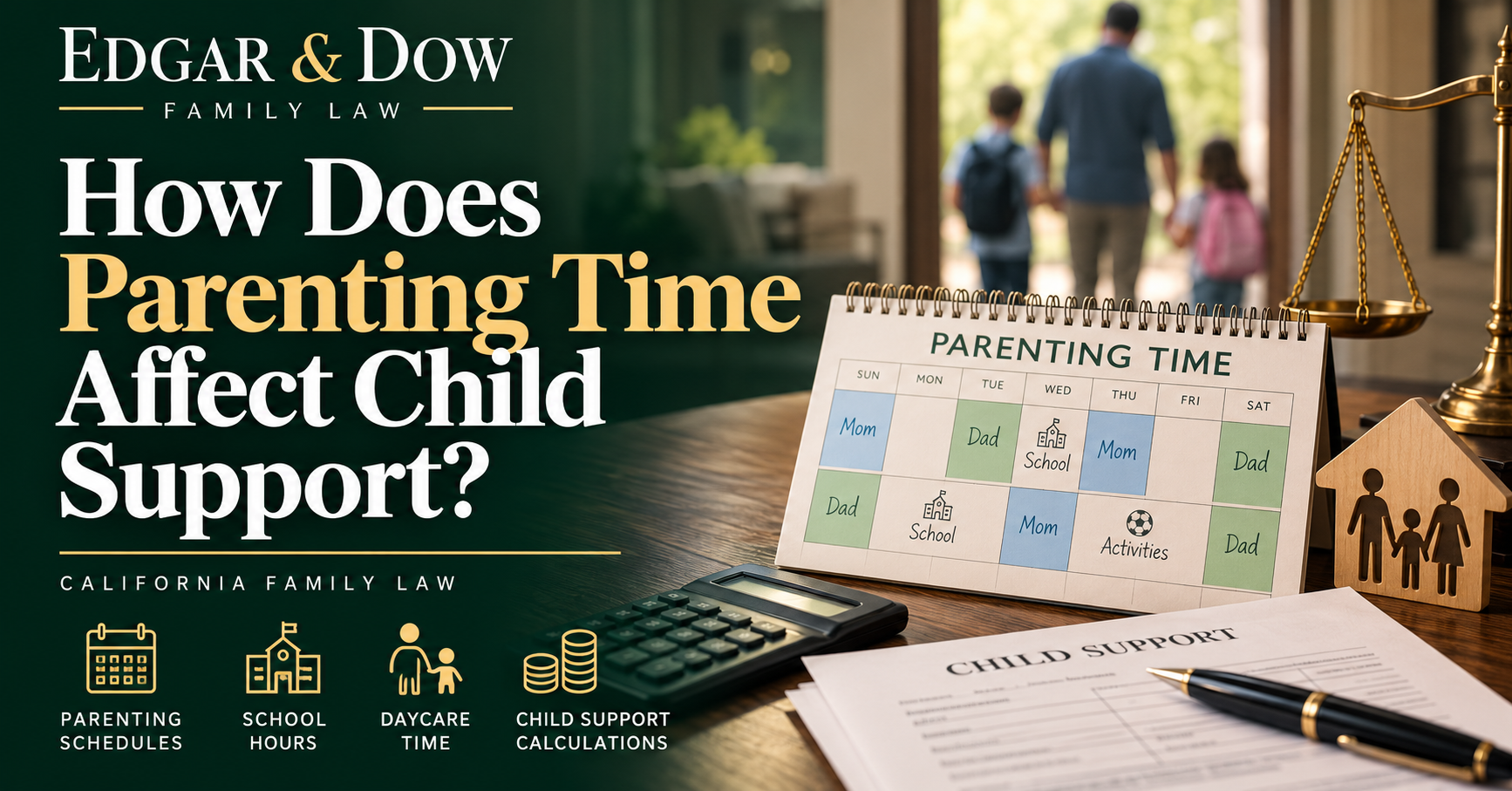
One of the most common questions I hear when discussing child custody and child support is whether spending more time with the children will reduce a parent’s child support obligation.
The answer is generally yes, particularly when the parent receiving additional parenting time is the higher-earning parent. But the relationship between custody and child support is more complicated than many parents realize.
California uses a statewide guideline formula to calculate child support. Two of the most important factors are the parents’ incomes and the percentage of time they are responsible for their children.
That second factor is commonly called parenting timeshare.
A higher-earning parent who has the children 20% of the time will generally have a significantly different child support calculation than the same parent exercising 40% parenting time, assuming the other information remains unchanged.
But determining the correct percentage is not always as simple as counting overnight visits or looking at the custody designation in a court order.
California Family Code section 4055 focuses on the percentage of time the higher-earning parent has, or will have, primary physical responsibility for the children.
That distinction matters.
Children spend substantial portions of their days at school, daycare and extracurricular activities. Parents may have custody orders that do not accurately reflect the schedules they actually follow. And sometimes the parents disagree about who should receive credit for particular periods of time.
At Edgar & Dow, we use Xspouse to calculate California guideline child support. The program performs the mathematics, but the parenting percentage entered into the calculation must be accurate.
An incorrect timeshare percentage can substantially affect the amount of support ordered.
California Family Code section 4055 establishes the statewide guideline child support formula.
One component of that formula is commonly referred to as H%, which represents the approximate percentage of time the higher-earning parent has or will have primary physical responsibility for the children compared with the other parent.
Generally, as the higher earner’s parenting timeshare increases, the guideline child support obligation decreases, assuming the other inputs remain unchanged.
The reason is that California recognizes both parents incur expenses while caring for their children. A parent exercising more parenting time ordinarily assumes additional responsibility for housing, food, transportation and other expenses associated with raising the children.
The guideline accounts for those responsibilities through the parenting-timeshare adjustment.
But the calculation also considers the parents’ respective incomes.
For example, suppose the parents share physical responsibility for their children equally, but one parent earns $15,000 per month while the other earns $5,000.
Even with a 50/50 parenting schedule, the higher-earning parent may still be required to pay substantial child support.
California’s guideline is designed to account for differences in income and the principle that children should share in their parents’ standard of living.
Equal parenting time does not necessarily mean equal financial resources.
This is why obtaining a 50/50 parenting schedule does not automatically eliminate child support.
One of the most common misconceptions about California child support is that an order for joint physical custody automatically establishes equal parenting time.
It does not.
Joint physical custody is a custody designation. Parenting timeshare is a calculation based upon the approximate percentage of time each parent has primary physical responsibility for the children.
Those are different concepts.
Parents may have an order for joint physical custody but follow a schedule in which the children spend substantially more time with one parent.
For example, the children may reside primarily with one parent during the school week and spend alternating weekends and certain holidays with the other parent.
The custody order may describe the arrangement as joint physical custody, but the actual parenting timeshare may be far from equal.
California courts have recognized that the guideline focuses on physical responsibility rather than the custody label.
In DaSilva v. DaSilva (2004) 119 Cal.App.4th 1030, the Court of Appeal examined how the statutory timeshare calculation should account for parental responsibility during periods when children are not physically with either parent.
The court emphasized the practical responsibilities associated with caring for children rather than simply relying upon the custody designation or counting overnight visits.
The important question is not merely what the custody order calls the arrangement.
It is who actually assumes responsibility for the children.
When calculating parenting timeshare, I generally begin by examining the entire parenting schedule over the course of a year.
Looking only at a typical weekend can be misleading because many custody orders contain different arrangements for school days, holidays and vacations.
For example, a parent may have alternating weekends during the school year but substantially more time during summer vacation. The parents may alternate Thanksgiving and winter break or divide spring break differently.
Those periods can materially affect the annual parenting percentage.
The calculation generally requires consideration of the regular weekday schedule, weekends, holidays, summer vacation and other parenting periods.
In straightforward cases, the percentage may be relatively easy to determine.
In more complicated arrangements, we may need to examine the actual hours of responsibility throughout the year.
But counting hours is not necessarily the end of the analysis.
California law recognizes that parents can remain responsible for their children even when the children are physically somewhere else.
That becomes particularly important when children attend school or daycare.
Children spend substantial portions of their weekdays at school. Younger children may attend daycare while their parents work.
During those hours, neither parent is physically caring for the child.
Does that mean those hours should be excluded from the parenting-timeshare calculation?
Not necessarily.
California courts have repeatedly recognized that the statutory concept of primary physical responsibility is broader than physical presence.
Three important decisions illustrate how this principle operates: In re Marriage of Whealon, DaSilva v. DaSilva, and In re Marriage of Katzberg.
In In re Marriage of Whealon (1997) 53 Cal.App.4th 132, the Court of Appeal addressed whether a parent should lose timeshare credit because the child attended daycare.
The court rejected the argument that daycare time automatically reduced the custodial parent’s physical responsibility.
The court recognized that the parent responsible for arranging childcare also assumes substantial practical obligations.
That parent may have to find an appropriate daycare provider, arrange and pay for care, transport the child, and leave work if the child becomes ill or another emergency occurs.
Those responsibilities do not disappear merely because the child is physically at daycare.
The significance of Whealon is that parenting timeshare cannot always be determined by asking where the child is physically located at a particular moment.
The court must consider which parent remains responsible for the child’s care.
The Court of Appeal addressed a related issue in DaSilva v. DaSilva (2004) 119 Cal.App.4th 1030.
The father was substantially involved in the child’s school activities and responsibilities.
Both parents were listed on the school’s emergency contact information and participated in school activities. The father frequently transported the child to school, participated in school events and cared for the child when ill.
The trial court had calculated parenting timeshare without adequately crediting the father’s responsibilities during school hours.
The Court of Appeal determined that at least some of those hours should have been included in his parenting percentage.
DaSilva is important because it demonstrates that school hours are not automatically assigned to one parent.
The court may consider evidence concerning who transports the child, responds to emergencies, participates in school activities and otherwise assumes responsibility during the school day.
That does not mean school hours must be divided equally.
The allocation depends upon the evidence concerning each parent’s actual responsibilities.
In In re Marriage of Katzberg (2001) 88 Cal.App.4th 974, the Court of Appeal considered parenting timeshare for a child attending boarding school.
The child was physically away from both parents for substantial periods.
Nevertheless, the court recognized that a parent could retain primary responsibility for the child’s physical situation and care while the child attended school.
The father, who was the primary custodial parent and responsible for emergencies, received timeshare credit for the child’s time at boarding school.
Katzberg reinforces the distinction between physical presence and parental responsibility.
Taken together, these decisions establish that school and daycare hours require consideration of the actual parenting arrangement.
A parent does not necessarily lose timeshare credit simply because a child is attending school or daycare.
Conversely, a parent should not automatically receive credit for those hours without evidence establishing the relevant responsibility.
Another common issue arises when the parents have a custody order but are not following it.
Sometimes the parents informally agree to change the schedule.
A parent may begin exercising additional weekday parenting time or assume greater responsibility for the children during the school year.
In other situations, a parent may stop exercising scheduled visitation.
The court must distinguish between the parenting schedule established by an order and the responsibility actually exercised during the relevant period.
This distinction became particularly important in County of San Diego v. P.B. (2020) 55 Cal.App.5th 1058.
In P.B., the trial court used a 29% parenting timeshare for the father during a historical period when he was not actually seeing the child.
The father had previously exercised parenting time, but the child was refusing contact.
There were allegations that the mother had interfered with visitation and the father’s efforts to maintain a relationship with the child.
The trial court nevertheless attributed the 29% timeshare to the father.
The Court of Appeal reversed.
The court concluded that the guideline calculation could not attribute nonexistent parenting time to the father as a means of addressing alleged interference with visitation.
During the disputed period, the father’s actual timeshare was zero.
The support calculation therefore had to reflect the actual circumstances.
This is an important distinction because custody disputes and child support disputes are governed by different legal considerations.
A parent may have legitimate complaints that the other parent is interfering with visitation.
Those complaints may warrant enforcement or modification of the custody order.
But the child support calculation cannot simply assign parenting time that was never exercised as a remedy for the alleged interference.
The appropriate remedy for a custody violation must be pursued through the applicable custody procedures.
There is an important difference between calculating support for a historical period and establishing support under a new parenting arrangement.
Family Code section 4055 expressly refers to the percentage of time the higher earner “has or will have” primary physical responsibility for the children.
The words “will have” are significant.
When the court establishes a new custody schedule, the child support calculation may reflect the parenting arrangement that will apply going forward.
For example, the court may establish a new equal-parenting schedule even though one parent previously exercised substantially less time.
The prospective support calculation can reflect the new schedule when the evidence supports its anticipated implementation.
The court should not simply assume that a historical arrangement will continue when it is entering a materially different prospective custody order.
The distinction is between parenting time that actually occurred during a disputed historical period and parenting responsibility that will exist under a new order.
Not every child in a family necessarily follows the same parenting arrangement.
For example, an older child may spend substantially more time with one parent because of school, activities or personal circumstances, while a younger child follows a different schedule.
Family Code section 4055 expressly addresses circumstances involving different parenting schedules for different children.
Under the statutory formula, the H% component generally reflects the average of the higher earner’s approximate timeshare percentages for the children.
The court may also need to consider other statutory provisions concerning the allocation of support.
The important point is that the parenting percentage should reflect the actual circumstances rather than assuming every child follows an identical schedule.
When the parents disagree about parenting time, the evidence becomes important.
A custody order is an obvious starting point, but it may not establish what actually occurred during the relevant period.
Depending upon the circumstances, I may want to review parenting calendars, communications concerning exchanges, school pickup records, daycare records, holiday schedules and documentation of missed or canceled visits.
When school or daycare responsibility is disputed, evidence concerning transportation, emergency contacts and the parents’ involvement in school activities may also be relevant.
The objective is to establish an accurate picture of the parenting arrangement.
A parent claiming a particular percentage should be prepared to explain how that percentage was determined.
Simply stating that the parents have joint physical custody does not establish a 50% timeshare.
Likewise, counting overnight visits without considering school, daycare, holidays and other responsibilities may produce an inaccurate result.
At Edgar & Dow, we review the parenting schedule and the relevant evidence before entering the timeshare percentage into Xspouse.
The computer performs the calculation, but the accuracy of the result depends upon the parenting percentage entered.
Yes.
A material change in parenting time can significantly affect the guideline calculation.
For example, a higher-earning parent who previously exercised alternating weekends may begin following an equal-parenting schedule.
That change can produce a substantially different child support calculation.
But changing the parenting schedule does not automatically modify an existing child support order.
A parent generally must obtain an appropriate modification of the support order rather than simply deciding to pay a different amount.
This distinction is particularly important because child support modification and retroactivity are governed by specific statutory requirements.
Parents should not assume that an informal change in custody automatically changes the amount they are legally required to pay.
If the parenting schedule has materially changed, the support obligation should be reviewed promptly.
Generally, when the higher-earning parent exercises more parenting time, guideline child support decreases if the other inputs remain unchanged. The actual result depends upon both parents’ incomes and the other information used in the calculation.
No. Equal parenting time does not necessarily eliminate child support. A substantial difference in the parents’ incomes may result in a support obligation even when the children spend equal time with both parents.
No. Joint physical custody is a custody designation. The timeshare calculation considers the approximate percentage of time the higher-earning parent has or will have primary physical responsibility for the children.
No. California law considers primary physical responsibility, which may include periods when children attend school, daycare or other activities.
The court may consider which parent assumes responsibility for transportation, emergencies, school activities and other aspects of the child’s care. Under DaSilva v. DaSilva, school hours should not be excluded without considering evidence of parental responsibility.
It can. Under In re Marriage of Whealon, a parent does not automatically lose timeshare credit because the child attends daycare. The court may consider who arranges care, provides transportation, pays for care and responds to emergencies.
The court may need to distinguish the ordered schedule from the parenting responsibility actually exercised. Under County of San Diego v. P.B., nonexistent parenting time cannot simply be attributed to a parent when calculating support for a historical period.
Interference with visitation may raise important custody enforcement or modification issues. However, the court cannot simply assign nonexistent parenting time in the child support calculation as a remedy for alleged interference.
Yes. Family Code section 4055 contemplates parenting responsibility a parent has or will have. A prospective support calculation may reflect a new parenting schedule established by the court.
Family Code section 4055 provides for averaging the higher earner’s approximate timeshare percentages when children have different parenting arrangements.
No. A change in parenting time may support a modification, but an existing support order generally remains enforceable until appropriately modified.
When evaluating a California child support calculation, two of the first things I want to know are what each parent earns and how much parenting time each parent exercises.
Those figures can substantially affect the amount of support ordered.
A higher-earning parent exercising 20% parenting time and the same parent exercising 40% parenting time will generally have significantly different guideline results when the other inputs remain unchanged.
That is why the timeshare percentage deserves careful attention.
We cannot simply assume joint physical custody means 50/50 parenting time.
We cannot always determine the percentage by counting overnight visits.
We cannot ignore the responsibilities parents assume while children attend school or daycare.
And when the custody order differs from the parenting arrangement actually followed, we must determine which schedule is legally relevant to the support period being considered.
California law focuses on primary physical responsibility for the children.
That is the percentage we need to determine before preparing the guideline calculation.
The parenting percentage used in your child support calculation can significantly affect how much support you pay or receive.
An incorrect percentage can result in a support order that does not accurately reflect the parenting responsibilities you actually assume.
Does your custody order reflect the schedule you follow?
Are school and daycare hours being allocated correctly?
Are you exercising more parenting time than the other parent acknowledges?
Has your parenting schedule changed since the last support order?
Or are you establishing custody and child support for the first time?
These are important questions to address before the court determines support.
At Edgar & Dow, we have nearly three decades of experience representing parents in California family law proceedings. We handle contested custody and child support matters throughout Riverside County, Murrieta, Temecula, San Bernardino County and Southern California.
We review custody orders, parenting schedules, school and daycare responsibilities, financial disclosures and guideline calculations to determine whether the appropriate parenting percentage is being used.
Whether you are a mother or father, paying child support or receiving it, an inaccurate timeshare calculation can have significant financial consequences.
If you are preparing for a child support hearing, seeking to modify an existing order or questioning the parenting percentage used in your calculation, contact Edgar & Dow to schedule a consultation.
Schedule a Consultation With Edgar & Dow
Your parenting time matters. So does getting the child support calculation right.
3895 12th Street
Riverside, CA 92501
Text Us: +1 (951) 307-0845
1855 W Katella Ave Suite 265
Orange, CA 92867
41870 Kalmia St, Suite 115,
Murrieta, CA 92562
Text Us: +1 (951) 618-2558
77-711 Flora Road Suite 203
Palm Desert, CA 92211
© Copyrights 2026 Edgar & Dow. All Rights Reserved. Disclaimer | Privacy Policy
*Images are obtained under license from Canva and other third-party stock image providers, with attribution included where required.
Digital Marketing by

