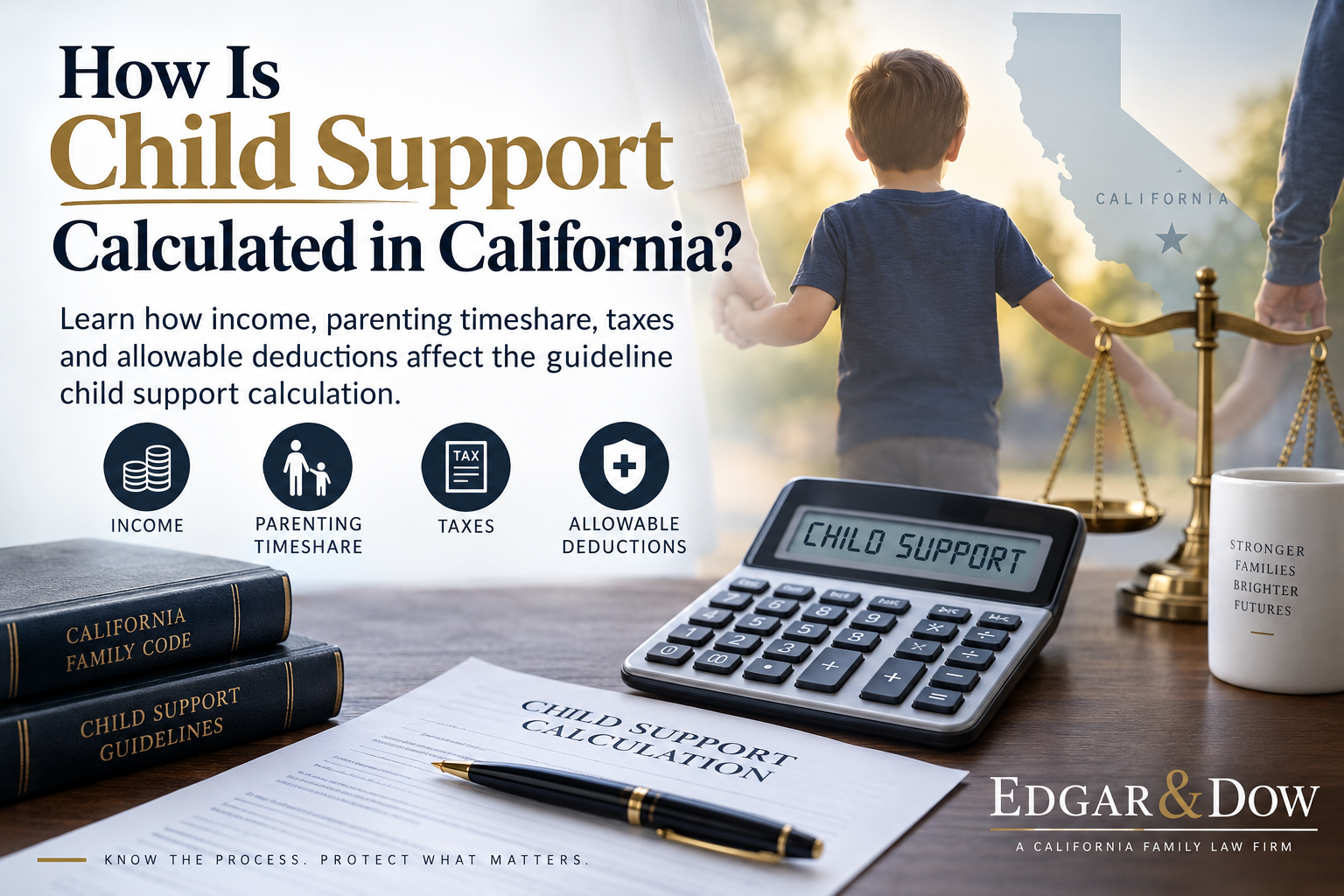
“How much child support will I have to pay?”
Or:
“How much child support should I receive?”
Those are two of the most common questions we hear in California family law consultations.
California uses a statewide uniform guideline to calculate child support. Although the formula is contained in Family Code section 4055, nobody is sitting in the courtroom calculating the formula by hand.
The calculation is done by computer.
At Edgar & Dow, we use Xspouse. The computer does the math. What matters in most child support cases is making sure the correct information is entered into the program.
For most ordinary cases, two inputs drive the calculation more than anything else:
The program then takes into account the appropriate tax settings, allowable deductions and other required information.
The computer does the math.
The case is usually about the inputs.
For most cases, I want to know two things first:
What does each parent earn?
And:
What is the parenting timeshare?
Those two inputs can have a significant effect on guideline child support.
From there, we enter the appropriate tax information and allowable deductions. Common deductions include health insurance premiums, mandatory retirement contributions and mandatory union dues.
Once the correct information is entered, the computer performs the guideline calculation.
Yes.
Family Code section 4055 establishes California’s statewide guideline formula.
The formula incorporates the parents’ net monthly disposable income and the approximate percentage of time the higher earner has primary physical responsibility for the children.
The actual formula is complicated.
For most parents, however, understanding the algebra behind it is not particularly useful because the support program performs the calculation automatically.
What matters is whether the correct numbers went into the program.
No.
In actual California family law practice, guideline child support is calculated using computer software.
At Edgar & Dow, we use Xspouse.
The Department of Child Support Services also uses computerized guideline calculations in cases involving DCSS.
The computer applies California’s statutory guideline to the information entered into it.
The attorney’s job is not to sit down and perform the mathematical formula.
The attorney’s job is to determine whether the correct income, timeshare, tax information, deductions and other inputs are being used.
For most ordinary cases:
Income and timeshare.
A substantial change in either one can substantially change the child support calculation.
If the income changes, support changes.
If the parenting timeshare changes, support changes.
That is why we spend so much time making sure those two inputs are accurate.
Gross income is one of the principal inputs in a California child support calculation.
California Family Code section 4058 broadly defines annual gross income as income “from whatever source derived,” subject to statutory exceptions.
For someone earning a regular salary, determining gross income may be relatively straightforward.
For other parents, it can become one of the most disputed issues in the case.
Income can include much more than base salary or hourly wages. Depending upon the circumstances, a parent may have:
Determining the correct income figure can therefore require considerably more work than simply looking at someone’s hourly rate.
We address gross income, bonuses, commissions, overtime, fluctuating income and income averaging separately in this child support series.
For purposes of the basic guideline calculation, the point is straightforward:
The income entered into the program matters.
Yes. Significantly.
Parenting timeshare is one of the principal inputs in California’s guideline child support calculation.
The formula considers the approximate percentage of time the higher earner has primary physical responsibility for the children.
As that percentage changes, the guideline calculation changes.
A 20% timeshare and a 40% timeshare will produce significantly different guideline results when the other inputs remain the same.
That is why accurately determining parenting timeshare is just as important as accurately determining income.
No.
This is one of the most common misconceptions about California child support.
Equal parenting time does not necessarily result in zero child support.
Income matters too.
If the parents share parenting time equally but one parent earns substantially more than the other, the guideline can still produce a significant child support order.
California’s child support system considers both income and responsibility for the children.
So:
50/50 custody does not automatically mean zero child support.
No.
The custody label does not determine the percentage entered into the child support calculation.
Parents can have an order for joint physical custody without necessarily having an exact 50/50 parenting schedule.
For child support purposes, we are concerned with the actual percentage of physical responsibility for the children.
That is the timeshare that matters to the guideline calculation.
We look at the actual parenting schedule.
How much time does the child spend with each parent?
What happens during the school week?
Weekends?
Holidays?
Vacations?
If the parents agree on the schedule and resulting timeshare, this can be relatively straightforward.
If they disagree about how much parenting time is actually being exercised, timeshare itself can become a contested issue.
The computer cannot decide which parent is correct.
It calculates support based upon the timeshare entered.
No.
This is an important distinction.
The support program does not simply look at the federal and state taxes withheld from your paycheck and subtract those amounts from gross income.
The appropriate tax settings are entered into the support program.
The program then calculates the tax consequences used in determining guideline support.
Tax withholding and tax liability are not necessarily the same thing.
A parent can change the amount withheld from a paycheck.
That does not mean the parent can change guideline child support simply by changing paycheck withholding.
Not simply.
Take-home pay is whatever remains after an employer makes all of the deductions appearing on the paycheck.
Some of those deductions may be relevant to child support.
Others may not be.
California begins with gross income and applies the deductions authorized by law in determining net disposable income.
The support program also calculates the applicable tax consequences based upon the tax settings entered into it.
That is why simply looking at the amount deposited into a parent’s checking account does not tell us what the child support calculation will be.
California guideline child support ultimately uses net monthly disposable income.
The basic concept is straightforward.
We start with gross income.
We enter the appropriate tax information.
We apply the deductions California law permits.
The program calculates net disposable income and uses it in the guideline calculation.
Again, the computer does the mathematical work.
The important issue is making sure the information entered is correct.
Not every expense a parent pays is a child support deduction.
California law identifies the deductions that may be considered in determining net disposable income.
Some of the common deductions we see include:
The fact that a parent pays an expense every month does not automatically make it a deduction from income for child support purposes.
A mortgage payment, car payment, credit-card payment or ordinary household expense does not simply get entered as a deduction because the parent has to pay it.
Yes.
Health insurance premiums are one of the common deductions that can affect net disposable income and therefore the guideline calculation.
The correct premium should be entered when the child support calculation is prepared.
Yes.
Mandatory retirement contributions can be included in determining net disposable income.
The word “mandatory” is important.
A required retirement contribution is different from voluntarily deciding to put additional income into a retirement account.
A parent cannot simply choose to divert substantial income into voluntary retirement savings and assume that doing so automatically reduces child support.
Yes.
Mandatory union dues are another common deduction that can affect a California child support calculation.
This frequently arises with employees whose employment requires payment of union dues.
The appropriate amount needs to be entered into the program.
Yes.
Child support is based upon current income.
For someone earning a fixed salary, determining current income may be relatively simple.
For someone whose earnings change substantially throughout the year, the issue becomes more complicated.
A parent may receive:
Those circumstances may require examination of a longer income history to determine a fair and representative current income figure.
We address those issues separately in our article concerning gross income for California child support.
Not necessarily.
Tax returns are important evidence.
But a tax return reports income from a prior tax year.
California child support is concerned with current income.
If someone’s income has legitimately changed since the last tax return, current paycheck information and other evidence may be necessary.
On the other hand, if income fluctuates substantially, historical earnings can help determine whether the current income is representative.
That is why child support calculations involving bonuses, commissions, overtime and seasonal income require additional analysis.
Self-employment can make determining income considerably more complicated.
Business revenue is not necessarily the same thing as income available for child support.
Likewise, the fact that an expense appears on a business tax return does not necessarily answer how that expense should be treated for child support.
Self-employment deserves its own article in this series.
Once the appropriate income figure is determined, however, the basic principle remains the same:
We enter that income into the support program and the computer calculates guideline support.
They can affect child support.
The more difficult question is often determining the appropriate income figure when compensation fluctuates.
Was the bonus unusual or recurring?
Is overtime regularly available?
Are commissions seasonal?
Does the current year accurately represent what the parent normally earns?
Those are income questions rather than problems with the child support formula.
We will address them separately in our gross-income and fluctuating-income articles.
Generally, no.
Family Code section 4057.5 generally prevents a new spouse’s or nonmarital partner’s income from being considered in determining child support except in specified extraordinary circumstances.
There can be tax consequences associated with remarriage that affect the calculation.
That is different from simply adding the new spouse’s salary to the parent’s income.
Certain support obligations involving other children can affect the guideline calculation.
California law contains provisions addressing qualifying child support actually being paid for other children and potential hardship deductions involving certain other children a parent is obligated to support.
These are specific statutory adjustments.
A parent cannot simply estimate how much another child costs each month and subtract that amount from income.
Not necessarily.
California distinguishes between basic guideline child support and additional child support obligations commonly called “add-ons.”
Qualifying employment-related childcare expenses can be ordered in addition to basic guideline child support.
We will address child support add-ons separately in this series.
Certain uninsured healthcare expenses can also be additional child support obligations.
This means the basic monthly guideline number does not necessarily represent everything the parents may be required to contribute toward their children.
There can be basic guideline support plus additional support obligations.
No.
The computer calculation produces the presumptively correct guideline amount.
But California law permits the family court to order an amount different from guideline when the statutory requirements for a deviation are established.
The court must first accurately calculate guideline support before determining whether there is a legal basis to depart from it.
We address that issue in detail here:
Can a California Court Order Less Than Guideline Child Support?
Because different inputs produce different results.
Suppose one calculation uses:
$10,000 per month in gross income and a 20% timeshare.
Another calculation uses:
$12,000 per month in gross income and a 35% timeshare.
Those calculations will produce significantly different guideline results.
The same thing happens when calculations use different:
The computer is not deciding which set of facts is correct.
It calculates support based upon the information entered.
That is why, when someone tells me:
“Child support came out to $2,500,”
I want to see the calculation.
My next question is:
“What numbers did you use?”
California uses a statewide uniform guideline. Computer software performs the mathematical calculation using the parents’ income, parenting timeshare, appropriate tax settings, allowable deductions and other required inputs.
For most ordinary cases, gross income and parenting timeshare are two of the most important inputs.
No. Computer software performs the guideline calculation. The attorney’s role includes determining whether the proper factual and legal inputs are being used.
Yes. Parenting timeshare is a direct component of California’s guideline formula. A 20% timeshare and a 40% timeshare will produce significantly different guideline calculations when the other inputs remain the same.
No. Equal parenting time does not necessarily eliminate child support because the parents’ incomes are also part of the calculation.
No. The actual parenting responsibility matters for child support, not simply the custody label.
Not simply. The support program calculates tax consequences using the appropriate tax settings rather than merely accepting whatever tax withholding appears on the paycheck.
Not simply. California uses statutory gross income and net disposable income rather than merely using the amount deposited from a paycheck.
Yes. Health insurance premiums can affect net disposable income and therefore the guideline calculation.
Yes. Mandatory retirement contributions can affect the calculation. Voluntary retirement contributions are different.
Yes. Mandatory union dues can affect net disposable income.
Not necessarily. Child support is based upon current income. Tax returns are important evidence, but additional information may be necessary when income has changed or fluctuates.
They can. Determining how recurring, seasonal or fluctuating compensation should be treated requires a more detailed income analysis.
Yes. California law permits deviation from presumptively correct guideline support when the statutory requirements are established.
California child support does not need to be mysterious.
The computer performs the guideline calculation.
For most ordinary cases, I want to know two things first:
What does each parent earn?
And:
What is the parenting timeshare?
Those two inputs can dramatically affect the result.
Then we enter the appropriate tax settings and allowable deductions, including items such as health insurance, mandatory retirement and mandatory union dues.
The program does the rest.
A straightforward case involving two W-2 employees, an undisputed parenting schedule and ordinary deductions can often be calculated relatively quickly.
The cases become more complicated when the parents disagree about the inputs.
What is the correct gross income?
What is the correct timeshare?
Does someone receive substantial bonuses, commissions or overtime?
Is the income seasonal or fluctuating?
Is someone self-employed?
Is a claimed deduction legally permitted?
Those are the issues that can materially change the child support calculation.
The computer does the math.
The important question is whether the right numbers went into it.
Whether you expect to pay child support or receive it, an accurate guideline calculation begins with accurate information.
Edgar & Dow represents parents in child support matters throughout Riverside County, San Bernardino County and Southern California.
If you need to establish child support, respond to a request for support, or determine whether the correct income, parenting timeshare, tax settings and deductions are being used, contact Edgar & Dow to schedule a consultation.
We can review the guideline calculation and, more importantly, the information being used to produce it.
3895 12th Street
Riverside, CA 92501
Text Us: +1 (951) 307-0845
1855 W Katella Ave Suite 265
Orange, CA 92867
41870 Kalmia St, Suite 115,
Murrieta, CA 92562
Text Us: +1 (951) 618-2558
77-711 Flora Road Suite 203
Palm Desert, CA 92211
© Copyrights 2026 Edgar & Dow. All Rights Reserved. Disclaimer | Privacy Policy
*Images are obtained under license from Canva and other third-party stock image providers, with attribution included where required.
Digital Marketing by

