When calculating child support in California, one of the first things I examine is the income each parent earns. But determining gross income is only part of the calculation. We also need to determine which deductions California law permits before calculating the parent’s net disposable income.
This is an area where misunderstandings are common. Some parents believe child support should be based upon the amount deposited into their bank account each payday. Others assume that because they have a substantial mortgage, car payment, credit-card debt or other monthly expenses, those payments should automatically reduce their child support obligation.
Neither assumption is correct.
California uses a statewide guideline formula to calculate child support. The parents’ incomes and parenting timeshare are two of the most important factors, but the calculation also considers taxes and certain deductions specifically authorized by law.
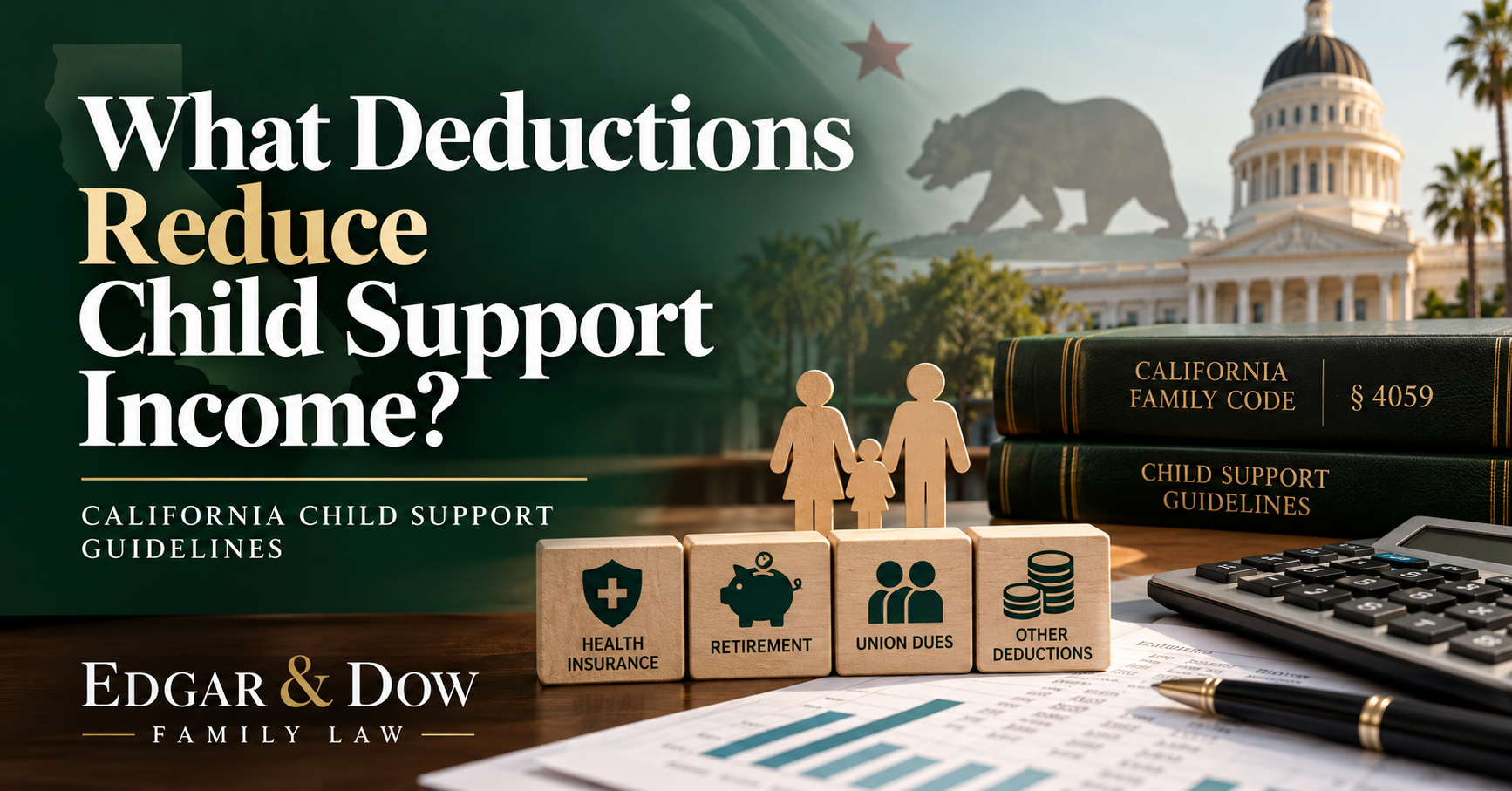
Family Code section 4059 identifies the deductions used to determine net disposable income. For most employees, the deductions we encounter most frequently involve health insurance premiums, mandatory retirement contributions and mandatory union dues. Other deductions may apply depending upon the parent’s financial circumstances.
But there is another important distinction. An expense that does not qualify as a deduction may still be relevant when the court considers whether the resulting guideline child support obligation is unjust or inappropriate.
California law permits courts to deviate from guideline under specified circumstances. This can become particularly important when the support calculation leaves a parent without sufficient resources to meet necessary basic living expenses.
At Edgar & Dow, we use Xspouse to calculate guideline child support. The program performs the mathematical calculation, but the accuracy of the result depends upon the information entered.
That is why I want to examine the parent’s paycheck stubs, Income and Expense Declaration and supporting financial records before preparing the calculation.
California Family Code section 4058 broadly defines gross income as income from whatever source derived, subject to statutory exceptions. That may include wages, salaries, overtime, bonuses, commissions, rental income, investment income and business income.
But the guideline formula does not simply use gross income.
Family Code section 4059 identifies the deductions used to determine annual net disposable income. Section 4060 generally converts that amount into a monthly figure.
The resulting net disposable income is used in the statewide guideline calculation, together with parenting timeshare and the other statutory factors.
For an ordinary W-2 employee, determining gross income may be relatively straightforward. We begin with the current paycheck stubs, examine year-to-date earnings and determine whether those earnings fairly represent current compensation.
The next step is identifying the deductions permitted by law.
The important point is that net disposable income for child support purposes is not necessarily the same as take-home pay.
A paycheck may reflect voluntary retirement contributions, additional tax withholding, employee benefits and other deductions that do not necessarily reduce income available for child support.
The fact that an employer deducts an amount from a paycheck does not automatically make that amount deductible under Family Code section 4059.
One of the most common misconceptions about child support concerns payroll taxes.
An employee may look at a paycheck and assume that the amount withheld for federal and state income taxes is the amount the court will deduct when calculating support.
That is not how the guideline calculation works.
The appropriate tax settings are entered into Xspouse. The program then calculates the applicable tax consequences used to determine net disposable income.
Tax withholding and actual tax liability are not necessarily the same thing.
Some employees elect to have additional taxes withheld from their paychecks. Others may have insufficient withholding and owe additional taxes when filing their returns.
A parent cannot ordinarily reduce child support simply by increasing voluntary tax withholding. Likewise, insufficient withholding does not mean the parent has no tax liability.
The support calculation must use the appropriate tax information under California law.
Tax filing status, applicable deductions, dependents and other relevant tax settings can affect the calculation. Those settings should reflect the parent’s actual circumstances and the tax treatment applicable to the support period.
This is one reason the Income and Expense Declaration and supporting financial records are important. We need accurate information rather than simply copying the deductions printed on a paycheck.
For many employees, the most common deductions we examine involve health insurance, retirement contributions and union dues. These are expressly addressed in Family Code section 4059.
Family Code section 4059(d) permits deductions for qualifying health insurance or health plan premiums.
The deduction is not limited to insurance covering the children involved in the support proceeding. The statute also permits qualifying premiums for the parent and children the parent has an obligation to support.
For example, suppose an employee pays $450 per month for health insurance through payroll deductions. That expense may reduce the employee’s net disposable income for guideline purposes.
The correct amount must be established, however. We need to distinguish the premium actually paid by the employee from any portion paid by the employer.
The qualifying employee-paid amount is what matters for the deduction.
Family Code section 4059(c) permits deductions for retirement contributions required as a condition of employment.
This distinction is particularly important for employees participating in mandatory pension systems. For example, some public employees are required to contribute a percentage of their earnings to a retirement plan as a condition of employment.
Those mandatory contributions may qualify as deductions. But voluntary retirement contributions are treated differently.
A parent cannot ordinarily reduce income available for child support simply by electing to contribute additional money to a retirement account.
In In re Marriage of Morton (2018) 27 Cal.App.5th 1025, the Court of Appeal addressed the treatment of voluntary retirement contributions in determining income available for support.
Suppose an employee earns $10,000 per month and voluntarily contributes $1,500 to a 401(k). The employee may believe that the support calculation should treat monthly income as only $8,500.
Generally, that is not correct.
The voluntary contribution does not ordinarily reduce the income available for child support in the same manner as a mandatory contribution required by employment.
Family Code section 4059(c) also permits deductions for mandatory union dues.
This commonly applies to employees whose employment requires payment of qualifying union dues. The amount should be identified from the paycheck or other employment records.
Not every professional membership or voluntary association fee qualifies as a mandatory union deduction. The legal character of the expense matters.
Family Code section 4059 also addresses qualifying Social Security and Medicare contributions, or their statutory equivalents, together with state disability insurance premiums.
For most W-2 employees, these amounts are reflected in payroll records and accounted for in the guideline calculation.
Again, the objective is to identify the correct statutory deductions rather than simply subtract every amount withheld by the employer.
Another issue arises when a parent is already paying child support or spousal support under a separate court order.
Family Code section 4059(e) permits deductions for certain qualifying support obligations actually being paid to or for the benefit of a person who is not the subject of the current support proceeding.
For example, a parent may already be paying court-ordered child support for a child from a prior relationship. That payment may qualify as a deduction when determining income in another child support case.
But the statute requires proof that the support is actually being paid. The existence of a court order alone does not necessarily establish the deduction.
If the parent has an order requiring $1,000 per month but is not making the payments, the unpaid obligation does not automatically reduce income available for support in the new proceeding.
The court needs evidence of actual payment.
California law also recognizes certain qualifying voluntary child support payments for natural or adopted children who do not reside in the parent’s home and are not the subject of the current proceeding. Those payments are subject to statutory limitations.
In either situation, documentation is important. Payment histories, bank records, court orders and other supporting evidence may be necessary to establish the deduction.
Payments toward past-due support can require additional examination. A parent should not assume that every payment toward arrears or interest automatically qualifies in the same manner as current support.
The nature of the obligation and the actual payments must be evaluated under the statute.
Some employees incur expenses directly associated with their employment that are not reimbursed by their employer. California Family Code section 4059(f) permits the court to consider certain job-related expenses when determining net disposable income.
The statute requires the court to consider whether the expenses are necessary, the benefit to the employee and other relevant circumstances.
For example, an employee may be required to purchase specialized tools, uniforms, equipment or other items necessary to perform the job. Those expenses may qualify for consideration.
Transportation expenses can present more complicated questions.
In Stewart v. Gomez (1996) 47 Cal.App.4th 1748, the Court of Appeal addressed the treatment of employment-related expenses under section 4059(f). Depending upon the circumstances, qualifying expenses may include parking, transportation or mileage associated with employment.
The fact that an expense involves commuting does not automatically disqualify it. But neither does every commuting expense automatically qualify.
The court must evaluate whether the expense is necessary, whether it is reimbursed by the employer and the other circumstances required by the statute.
When a parent claims substantial employment expenses, I want to examine the supporting documentation and understand why those expenses are necessary.
The court is not required to accept an unsupported estimate merely because the parent lists it on an Income and Expense Declaration.
Many parents are surprised to learn that ordinary household expenses are not automatically deducted from gross income when calculating guideline child support.
A parent may have a substantial mortgage, expensive car payment or significant credit-card obligations. Those expenses may create genuine financial pressure.
But Family Code section 4059 does not simply permit parents to subtract all of their monthly living expenses from gross income.
Mortgage payments, rent, personal vehicle payments, ordinary consumer debt and attorney’s fees generally are not statutory deductions used in the guideline calculation.
There is, however, an important distinction between an ordinary deduction and a special circumstance that may justify a departure from guideline.
In County of Lake v. Antoni (1993) 18 Cal.App.4th 1102, the Court of Appeal upheld a downward deviation involving extraordinary preexisting debt incurred for reasonable living needs and the parent’s other support responsibilities.
But the existence of substantial debt does not automatically justify reducing support.
In County of Stanislaus v. Gibbs (1997) 59 Cal.App.4th 1417, the Court of Appeal distinguished Antoni where the parent had not adequately established the nature of the debts and the household’s available financial resources.
The court must examine the evidence and determine whether the circumstances satisfy California’s statutory requirements.
The distinction is important. A credit-card payment may not qualify as an ordinary deduction, but extraordinary financial circumstances may still be relevant to a properly supported request for deviation.
California also recognizes certain hardship deductions under Family Code sections 4070 through 4073. These provisions address specific circumstances involving extreme financial hardship.
Qualifying circumstances may include extraordinary health expenses, uninsured catastrophic losses and certain minimum basic living expenses associated with natural or adopted children from other relationships who reside with the parent.
For example, a parent may incur extraordinary medical expenses that are not covered by insurance. Another parent may experience a catastrophic uninsured loss. A parent may also have qualifying support responsibilities involving children from another relationship who reside in the household.
But the existence of one of these circumstances does not automatically establish entitlement to a hardship deduction.
Family Code section 4070 requires extreme financial hardship resulting from justifiable expenses associated with the circumstances identified in section 4071.
The court must evaluate the evidence and determine whether the statutory requirements have been satisfied.
No. This is an important distinction.
A parent may have children from a subsequent relationship who reside in the household. Those children may create additional financial responsibilities, but the birth or adoption of another child does not automatically reduce an existing child support obligation.
Family Code section 4071(a)(2) permits consideration of the minimum basic living expenses of qualifying natural or adopted children from other relationships who reside with the parent.
The parent must establish the statutory hardship requirements.
There is also a limitation on the amount of the deduction.
Under Family Code section 4071(b), the maximum hardship deduction for each qualifying resident child generally cannot exceed the amount of guideline support allocated to each child involved in the current support proceeding.
In In re Marriage of Paulin (1996) 46 Cal.App.4th 1378, the Court of Appeal addressed the importance of balancing competing support responsibilities.
The objective is not to provide less support for children from one relationship simply because the parent has children from another relationship. California law seeks to account fairly for the parent’s obligations to all qualifying children.
The court retains discretion concerning whether a hardship deduction should be allowed and, if so, in what amount, subject to the statutory requirements and limitations.
Ordinarily, the hardship deduction under Family Code section 4071(a)(2) applies to qualifying natural or adopted children, not stepchildren.
However, California law recognizes a narrow exception.
Under Family Code section 4057.5(d), when the court considers new-spouse income under the circumstances permitted by that statute, it must also allow the applicable hardship deduction based on minimum living expenses for qualifying resident stepchildren.
That is a different statutory situation from the ordinary hardship deduction for natural or adopted children.
The distinction matters because parents should not assume that every child living in the household automatically qualifies for a hardship deduction.
An allowed hardship deduction reduces the income used in the guideline calculation. It is not simply subtracted dollar for dollar from the resulting child support obligation.
There is also an important distinction between a statutory hardship deduction and a special-circumstances deviation under Family Code section 4057.
They are separate legal mechanisms, and each has its own requirements.
Not every necessary living expense qualifies as a deduction under Family Code section 4059. But that does not necessarily mean the expense is irrelevant.
Family Code section 4057 permits courts to order child support different from the presumptively correct guideline amount when a statutory basis is established.
Section 4057(b)(6) permits deviation when applying guideline would be unjust or inappropriate because of special circumstances in the particular case.
The statute identifies several examples, but those examples are not exclusive.
In In re Marriage of de Guigne (2002) 97 Cal.App.4th 1353, the Court of Appeal recognized substantial judicial discretion to address unusual circumstances consistent with California’s child support policies.
One particularly important decision is City & County of San Francisco v. Miller (1996) 49 Cal.App.4th 866.
In Miller, the guideline calculation, even after the applicable low-income adjustment, would have left the paying parent with virtually nothing to meet ordinary living expenses after paying rent.
The Court of Appeal upheld a downward deviation under the special-circumstances provision.
Miller does not mean that every parent whose expenses exceed income is entitled to a reduction. The court must examine the actual circumstances, the reasonableness of the expenses, the children’s interests and the statutory child support policies.
The court must first calculate the presumptively correct guideline amount, including the appropriate deductions. It then determines whether the evidence establishes a legally recognized basis for departing from that amount.
When the court orders non-guideline support, it must make the findings required by Family Code section 4056.
The distinction is important. A mortgage payment may not qualify as a statutory deduction. A car payment may not qualify as a statutory deduction. Ordinary household expenses generally do not qualify as statutory deductions.
But necessary living expenses may still be relevant to a properly supported request for a special-circumstances deviation.
California substantially revised its child support guideline effective September 1, 2024, through Senate Bill 343.
Those amendments included significant changes to the statutory low-income adjustment.
However, the broader special-circumstances authority under Family Code section 4057(b)(6) existed before those amendments and remains available.
The distinction matters because a parent does not necessarily have to qualify for the statutory low-income adjustment to establish another legally recognized basis for deviation.
The court must first calculate guideline correctly, including the appropriate deductions. It then determines whether the evidence supports a departure from that amount.
When the court orders non-guideline support, it must make the findings required by Family Code section 4056.
When reviewing an Xspouse calculation, I do not look only at the guideline child support number. I also examine the cash-flow information showing what the parent has remaining after paying support.
That figure can become particularly important when the parent claims the guideline obligation leaves insufficient resources for necessary basic living expenses.
We then compare the net spendable income after support with the expenses reported on the parent’s Income and Expense Declaration.
The question is whether the evidence establishes circumstances that justify a deviation under California law.
A mortgage payment may not qualify as a statutory deduction, but necessary housing expenses may still be relevant to the court’s evaluation of special circumstances.
This is different from simply subtracting the mortgage payment from income. The court must apply the correct legal analysis.
For a more detailed discussion, see our companion article:
Can a California Court Order Less Than Guideline Child Support?
An accurate child support calculation begins with accurate financial information.
California’s Income and Expense Declaration, Judicial Council form FL-150, is one of the principal documents used to establish income, identify allowable deductions and provide information concerning the parent’s financial circumstances.
For most W-2 employees, I generally begin with current paycheck stubs. Those records can establish gross earnings, year-to-date compensation, health insurance premiums, mandatory retirement contributions and union dues.
The Income and Expense Declaration should accurately reflect that information.
If the parent claims other deductions, additional documentation may be necessary.
For example, a deduction for child support paid under another order may require payment records. A claimed employment expense may require receipts or evidence that the expense is necessary. A hardship deduction may require medical bills, insurance information or other supporting records.
The important point is that an accurately completed Income and Expense Declaration, together with appropriate attachments, ordinarily provides the foundation for establishing the financial facts necessary to calculate support.
But listing an expense on the form does not automatically make it deductible. The expense must qualify under California law.
The Income and Expense Declaration should be completed accurately, signed, filed with the court and served on the opposing party before the child support hearing, within the applicable filing and service deadlines.
Do not assume that bringing the declaration to court on the hearing date is sufficient.
The court and the opposing party should have the financial information and supporting documentation in advance so the guideline calculation can be reviewed and any disputed deductions identified.
An incomplete declaration, missing attachments or unsupported deductions can create unnecessary disputes and may affect the court’s ability to determine the correct support amount.
For example, if a parent claims a mandatory retirement contribution, the supporting paycheck stubs or employment records should establish that the contribution is required as a condition of employment. If the parent claims a deduction for support paid for another child, the supporting records should establish the actual payments. If the parent requests a hardship deduction, the declaration should identify the claimed hardship and include the necessary documentation.
The same principle applies when a parent requests a deviation from guideline because the resulting support obligation would leave insufficient income for necessary basic living expenses.
The Income and Expense Declaration provides the court with information about housing, transportation, utilities, debts and other financial obligations. That information can be compared with the net spendable income after support shown in the Xspouse calculation.
The court must still determine whether the evidence establishes a legally recognized basis for deviation. But without accurate financial information, the court may not have the evidence necessary to evaluate the request.
At Edgar & Dow, we carefully review the Income and Expense Declaration and supporting financial records before preparing the guideline calculation.
The computer performs the mathematics, but the accuracy of the result depends upon the accuracy of the information provided.
A properly completed, documented, filed and served Income and Expense Declaration is therefore one of the most important steps in preparing for a California child support hearing.
California begins with gross income and applies the deductions permitted under Family Code section 4059 to determine net disposable income. The guideline calculation uses the resulting figures together with parenting timeshare and other statutory factors.
No. The appropriate tax settings are entered into the child support calculation program, which calculates the applicable tax consequences. Payroll withholding does not necessarily equal actual tax liability.
Yes. Family Code section 4059(d) permits deductions for qualifying health insurance premiums covering the parent and children the parent has an obligation to support. The deduction is not limited to insurance for the children involved in the current case.
Generally, no. Retirement contributions required as a condition of employment may qualify under Family Code section 4059(c), but voluntary retirement contributions ordinarily do not reduce income available for guideline child support.
Yes. Family Code section 4059(c) permits deductions for qualifying mandatory union dues. Voluntary professional membership fees do not automatically qualify.
It can. Family Code section 4059(e) permits deductions for certain qualifying support payments actually made for children or other persons outside the current support proceeding. The parent must establish actual payment.
Potentially. Family Code section 4059(f) permits the court to consider qualifying job-related expenses, including certain necessary unreimbursed costs. The court evaluates whether the expenses are necessary, their benefit to the employee and other relevant circumstances.
Not as ordinary guideline deductions under Family Code section 4059. However, necessary living expenses may be relevant to a separate request for a special-circumstances deviation under Family Code section 4057.
Ordinary credit-card payments are not automatically deductible. However, extraordinary preexisting debt incurred for reasonable living needs may be relevant to a special-circumstances analysis, depending upon the evidence. The existence of substantial debt alone does not establish entitlement to reduced support.
A hardship deduction is a statutory adjustment available for qualifying extreme financial hardship under Family Code sections 4070 through 4073. Recognized circumstances include extraordinary health expenses, uninsured catastrophic losses and certain expenses associated with qualifying children from other relationships who reside with the parent.
No. A parent may qualify for a hardship deduction involving natural or adopted children from another relationship who reside in the household, but the deduction is subject to statutory requirements, limitations and judicial discretion.
Yes. Family Code section 4057 permits deviations when a statutory basis is established. Under section 4057(b)(6), the court may consider special circumstances that would make application of guideline unjust or inappropriate. The court must consider California’s child support policies and make the required findings.
That circumstance may support a request for a special-circumstances deviation, depending upon the evidence. In City & County of San Francisco v. Miller (1996) 49 Cal.App.4th 866, the Court of Appeal upheld a downward deviation where the support obligation would have left the paying parent with virtually nothing for necessary living expenses after paying rent. A reduction is not automatic.
The Income and Expense Declaration (FL-150), together with appropriate supporting documentation, provides the financial information necessary to evaluate income, allowable deductions, claimed hardships and potential deviations. An expense is not automatically deductible merely because it appears on the form.
The declaration and required supporting documentation should be filed and served before the child support hearing, within the applicable deadlines. Parents should not assume that bringing financial documents to court on the hearing date is sufficient.
When evaluating child support, we begin with the parents’ gross incomes and determine the deductions permitted by California law.
For most employees, the principal deductions involve taxes, health insurance premiums, mandatory retirement contributions and mandatory union dues. Other deductions may apply depending upon the circumstances.
But the analysis should not end there.
An expense that does not qualify as an ordinary deduction may still be relevant when the court considers whether guideline support produces an unjust or inappropriate result.
California law distinguishes between statutory deductions, hardship deductions and deviations from guideline. Each serves a different purpose and has different legal requirements.
That is why accurate financial disclosures are essential.
We need to determine the correct gross income, identify the allowable deductions, establish the appropriate tax settings and examine whether the resulting guideline obligation accurately reflects the circumstances.
When necessary, we must also evaluate whether the evidence supports a statutory hardship deduction or a special-circumstances deviation.
The computer calculates child support.
But first, we have to give it the correct information.
An incorrect deduction can significantly affect how much child support you pay or receive. And an inaccurate guideline calculation may result in a support obligation that does not properly reflect your financial circumstances.
Are your health insurance premiums being included?
Are your mandatory retirement contributions and union dues being deducted correctly?
Are you receiving credit for qualifying support payments made for children from another relationship?
Have necessary employment expenses been properly evaluated?
Does the guideline calculation leave you with insufficient income to meet your necessary basic living expenses?
These are important questions to address before the court enters a child support order.
At Edgar & Dow, we have nearly three decades of experience representing parents in California family law proceedings. We handle contested child support matters throughout Riverside County, Murrieta, Temecula, San Bernardino County and Southern California.
We review paycheck stubs, year-to-date earnings, tax information, Income and Expense Declarations, supporting financial records and Xspouse calculations to determine whether the appropriate income and deductions are being used.
We also evaluate whether the circumstances warrant consideration of a statutory hardship deduction or a deviation from guideline.
Whether you are establishing child support for the first time, seeking to modify an existing order or questioning the amount you have been ordered to pay or receive, obtaining an accurate calculation is essential.
If you are preparing for a child support hearing or believe your support calculation does not accurately reflect your financial circumstances, contact Edgar & Dow to schedule a consultation.
We can review the financial information, identify potential issues with the guideline calculation and help you understand the legal options available.
Schedule a Consultation With Edgar & Dow
The correct child support calculation begins with accurate financial information—and a careful understanding of California law.
3895 12th Street
Riverside, CA 92501
Text Us: +1 (951) 307-0845
1855 W Katella Ave Suite 265
Orange, CA 92867
41870 Kalmia St, Suite 115,
Murrieta, CA 92562
Text Us: +1 (951) 618-2558
77-711 Flora Road Suite 203
Palm Desert, CA 92211
© Copyrights 2026 Edgar & Dow. All Rights Reserved. Disclaimer | Privacy Policy
*Images are obtained under license from Canva and other third-party stock image providers, with attribution included where required.
Digital Marketing by

