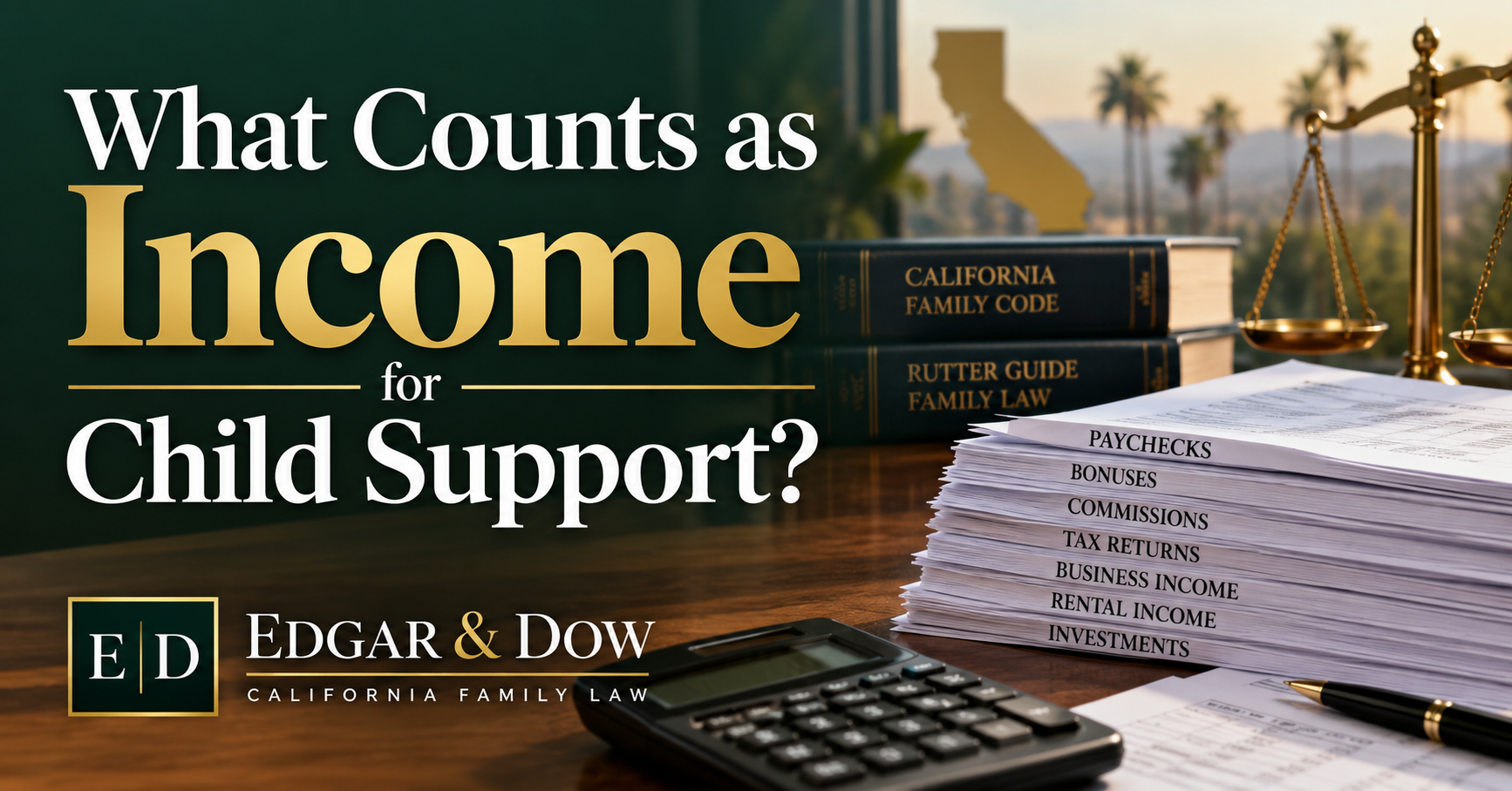
One of the first questions I ask when evaluating child support is how much each parent earns. It sounds like a straightforward question, but after nearly three decades of practicing family law, I can tell you that determining someone’s income is frequently one of the most contested issues in a child support proceeding.
For an employee earning a fixed salary, the answer may be relatively simple. For someone receiving overtime, commissions, bonuses, rental income or business income, determining the appropriate income figure can require considerably more analysis.
California uses a statewide guideline formula to calculate child support. Two of the most important factors are the parents’ incomes and their parenting timeshare. At Edgar & Dow, we use Xspouse to perform the guideline calculation. The computer does the mathematics, but before we can calculate support, we must determine what income should actually be entered into the program.
That distinction is important because an inaccurate income figure can produce a significantly different child support obligation. A parent should not be required to pay support based upon earnings that are not reasonably representative of current financial circumstances. Conversely, children should not receive less support because a parent’s income has been understated or important sources of compensation have been overlooked.
The objective is to determine an income figure that fairly reflects what the parent earns and can reasonably be expected to earn.
Family Code section 4058(a) defines annual gross income broadly as income “from whatever source derived,” subject to certain statutory exceptions.
The statute includes wages, salaries, commissions, bonuses, rents, dividends, interest, pensions, annuities, royalties, trust income and income from operating a business. It also includes many forms of government and employment benefits, including unemployment insurance, disability insurance, workers’ compensation and certain Social Security benefits.
The definition is intentionally broad. California’s child support system is designed to consider the financial resources available to parents rather than limiting the calculation to a person’s base salary.
For example, an employee may earn $90,000 annually in salary but receive another $30,000 in bonuses and commissions. Those additional earnings cannot simply be ignored because they are not part of the employee’s regular paycheck.
Similarly, a parent may earn relatively little from employment but receive substantial rental or investment income. Those sources may also affect the guideline calculation.
However, identifying a payment as income is only the beginning of the analysis. We must also determine how that income should be measured and whether it fairly represents the parent’s current and prospective earnings.
That is particularly important when compensation fluctuates throughout the year.
When evaluating income for a parent employed as a W-2 wage earner, I generally begin with the most recent paycheck stubs. In particular, I want to examine the year-to-date earnings.
The year-to-date figure is often more informative than the employee’s stated hourly wage or annual salary because it shows what the employee has actually earned during the reporting period. But before relying on that figure, we need to establish precisely what period it covers.
Many payroll systems begin their year-to-date calculations on January 1, but the reporting period should not simply be assumed. We also need to know whether the employee has worked throughout that period, whether compensation recently changed, and whether the reported earnings include unusual payments.
Consider an employee who earns $35 per hour. Based upon a regular 40-hour workweek, that employee would earn approximately $72,800 annually. But suppose the year-to-date paycheck figures suggest annual earnings of approximately $105,000.
That difference requires an explanation.
The employee may be working regular overtime, receiving shift differentials, earning commissions or receiving bonuses. Perhaps the employee recently received a substantial raise. Alternatively, the year-to-date total may include a one-time payment that will not recur.
Each possibility affects how we evaluate income.
If the additional compensation is regular and predictable, it may be appropriate to include it in the parent’s ordinary monthly earnings. If it is unusual or unpredictable, simply annualizing the year-to-date figure may produce an unrealistic result.
For example, suppose an employee earns $8,000 per month in base salary and receives a $24,000 annual bonus in March. If we examine the employee’s earnings in April and divide the year-to-date total by four months, we could substantially overstate the amount the employee receives in an ordinary month.
That does not mean the bonus should be excluded from child support. It means we must distinguish between regular compensation and additional earnings that are received at different times.
The same problem can occur in reverse. A seasonal employee may earn relatively little during the first few months of the year but substantially more during the summer. Annualizing the slower months could understate the employee’s actual annual income.
This is why a careful examination of compensation is necessary before preparing the guideline calculation.
Current paycheck stubs provide important information about present earnings, but they do not always tell the entire story. When compensation fluctuates, historical income records become particularly important.
California’s Income and Expense Declaration, Judicial Council form FL-150, requires financial disclosures and supporting documentation. Its instructions also direct parties to bring recent tax returns to court.
There is a practical reason for reviewing those returns. They allow us to compare current earnings with the parent’s historical income and identify patterns that may not be apparent from a few recent paychecks.
A commissioned salesperson may have an unusually successful year followed by a substantial decline. An employee may receive annual bonuses that vary considerably. A seasonal worker may earn most of the year’s compensation during a relatively short period.
By examining several years of tax returns, W-2 statements and current payroll records, we can better understand whether the income being reported is representative.
Tax returns are significant evidence because they are prepared under penalty of perjury and provide a documented history of earnings. However, the court is not necessarily bound by the figures appearing on a prior return.
In In re Marriage of Ciprari (2019) 32 Cal.App.5th 83, the Court of Appeal addressed the importance of considering financial information relevant to the period for which support is being determined, rather than relying exclusively on an earlier tax return.
Similarly, In re Marriage of Hein (2020) 52 Cal.App.5th 519 illustrates why a self-employed parent’s tax returns should not automatically be treated as conclusive evidence of income.
When more current and reliable evidence establishes different earnings, the court must evaluate that information. This is particularly important when income has changed materially or when a self-employed parent controls the financial records used to prepare the return.
California child support is concerned with current and prospective earnings. Family Code section 4060 permits appropriate adjustments when the ordinary annual calculation does not accurately reflect the parent’s actual or prospective income.
A parent who earned $150,000 last year may now have a legitimate reduction in earnings. Conversely, someone who earned $75,000 last year may have recently accepted a position paying substantially more.
The court should not mechanically use an outdated tax return when reliable evidence establishes materially different current circumstances.
The challenge is selecting an income figure that reasonably reflects the parent’s earnings rather than simply choosing the highest or lowest number available.
One of the most important California appellate decisions addressing fluctuating income is In re Marriage of Riddle (2005) 125 Cal.App.4th 1075.
Riddle involved a commissioned salesperson whose earnings varied substantially. The trial court calculated income using only the most recent two months of compensation.
The Court of Appeal concluded that the period was too short to provide a fair and representative picture of the parent’s earnings.
Two unusually successful months could substantially exaggerate the amount the parent was likely to earn going forward. Likewise, two unusually poor months could understate the parent’s actual earning circumstances.
The court explained that income averaging must use a representative period that reasonably predicts the parent’s likely immediate prospective earnings.
Riddle recognizes that the most recent twelve months is an appropriate benchmark in many cases, but it does not establish an inflexible twelve-month rule.
The appropriate period depends upon the nature of the income.
For example, twelve months may reasonably capture the annual compensation cycle of an employee receiving a regular salary and an annual performance bonus. Other occupations may have longer earnings cycles that require examination of several years.
A writer receiving royalties from a successful publication may experience unusually high income during one period followed by substantially lower payments. A real estate salesperson may have earnings affected by changing market conditions. A business owner may experience significant fluctuations because of industry conditions or changes in business operations.
In each situation, the court must determine what period fairly represents the parent’s income.
The purpose of averaging is not to guarantee that the highest historical earnings will continue indefinitely. Nor is it to permit a parent to avoid support by relying upon an unusually poor month.
The objective is a reasonable assessment of current and prospective income.
Bonuses, commissions and overtime are expressly or generally included within California’s broad definition of income. But determining how those earnings should affect monthly child support can present practical difficulties.
Some employees receive predictable overtime every pay period. Others work additional hours only during temporary staffing shortages or special projects.
A salesperson may receive substantial commissions during one quarter and very little during another. An executive may receive an annual performance bonus that depends upon company profitability or individual performance.
The income counts, but the timing and predictability of that income matter.
A parent receiving a substantial annual bonus may not have that money available during the preceding months. If the entire anticipated bonus is incorporated into a fixed monthly obligation, the parent may be required to make payments based upon compensation that has not yet been received and may never be paid.
The California Court of Appeal addressed this concern in In re Marriage of Mosley (2008) 165 Cal.App.4th 1375.
In Mosley, the parent had approximately $11,000 in monthly take-home base salary, while the combined child and spousal support obligation was approximately $10,000 per month. The support arrangement effectively required the parent to borrow money for ordinary living expenses while awaiting a potential discretionary year-end bonus.
The Court of Appeal concluded that the arrangement constituted an abuse of discretion.
Mosley does not hold that bonuses should be excluded from income. Rather, it demonstrates why the structure of the support obligation matters when substantial compensation is uncertain or received irregularly.
Not every bonus requires a separate additional-support order. Where bonuses are sufficiently regular and predictable, the court may appropriately include them in the ordinary guideline calculation.
In M.S. v. O.S. (2009) 176 Cal.App.4th 548, the Court of Appeal distinguished Mosley and upheld the inclusion of recurring semiannual bonus income in the guideline calculation.
The critical questions are whether the income is reasonably expected to continue and whether the resulting monthly obligation fairly reflects the parent’s financial circumstances.
California law provides mechanisms for addressing fluctuating income without necessarily requiring a parent to pay fixed monthly support based upon uncertain future compensation.
One commonly used approach is an Ostler-Smith order, named after In re Marriage of Ostler & Smith (1990) 223 Cal.App.3d 33.
Under an appropriately structured order, the court can establish a base support obligation using predictable income and provide for additional support when qualifying bonuses, commissions or other variable compensation are actually received.
For example, suppose a parent earns a regular salary of $120,000 annually but also receives a performance bonus that may range from nothing to $60,000.
Rather than treating the maximum possible bonus as guaranteed monthly income, the court may establish support based upon the regular salary and provide for additional support attributable to the bonus when it is paid.
At Edgar & Dow, Xspouse includes a Bonus Schedule that can calculate additional support based upon variable earnings above the amount used for base support.
A properly incorporated schedule can provide a practical method of determining the additional obligation without requiring the parents to return to court every time a bonus or commission is received.
Family Code section 4064 permits adjustments to accommodate seasonal or fluctuating income.
However, an Ostler-Smith order must be carefully structured. Although Family Code sections 4060 and 4064 permit adjustments for fluctuating income, a percentage-based additional support order must comply with California’s guideline requirements.
Under In re Marriage of Hall (2000) 81 Cal.App.4th 313, an order imposing additional support as a percentage of earnings may require an appropriate stipulation or the findings necessary to justify a departure from guideline.
The objective is to account for variable compensation without creating an unsupported or legally defective support order.
Although employment compensation is the most common source of income in child support proceedings, Family Code section 4058 extends considerably further.
Rental income, investment income, business income and certain benefits may all affect the calculation. These sources frequently require additional analysis because the amount reported for tax purposes does not necessarily establish the income available for child support.
Rental property provides a useful example.
A parent may receive substantial monthly rental payments but also incur legitimate expenses associated with operating the property. Gross rental receipts are not necessarily the same as income available for support.
However, California child support law does not automatically adopt every deduction permitted on a federal tax return.
In Asfaw v. Woldberhan (2007) 147 Cal.App.4th 1407, the Court of Appeal addressed the treatment of depreciation associated with rental property. The decision illustrates why tax deductions and child support deductions must be examined separately.
Business income can present similar problems.
Family Code section 4058(a)(2) generally addresses business proprietorship income by considering gross receipts reduced by expenditures required for operating the business.
But determining which expenses are genuinely necessary for business operations can be disputed. Some business owners pay personal expenses through their businesses, while others receive distributions or economic benefits that are not readily apparent from a simple review of salary.
A business tax return may therefore provide important evidence without conclusively establishing the correct income figure.
Investment income also matters. Dividends, interest, pensions, annuities, royalties and trust income may be included in gross income.
But we must distinguish income generated by an asset from the value of the asset itself. A parent who inherits an investment account has not necessarily earned the entire account balance as income, although interest or dividends subsequently generated by the account may be included.
Employee stock options can also constitute income for child support purposes. The timing of that income may be complicated because options can remain unexercised or produce substantial compensation irregularly.
In In re Marriage of Cheriton (2001) 92 Cal.App.4th 269 and In re Marriage of Kerr (1999) 77 Cal.App.4th 87, the courts addressed stock-related compensation and the need to structure support appropriately.
Employee benefits can also be relevant. Family Code section 4058 permits consideration of certain benefits that provide economic value or reduce living expenses.
For example, an employer may provide housing or a vehicle that reduces expenses the employee would otherwise pay personally.
Military housing and food allowances are expressly included in California’s statutory definition of gross income. In re Marriage of Stanton (2010) 190 Cal.App.4th 547 addresses the treatment of military allowances for support purposes.
Other sources expressly recognized by section 4058 include unemployment insurance, disability insurance and workers’ compensation benefits.
Not every government benefit is included, however. Need-based public assistance, including Supplemental Security Income, is generally excluded under section 4058(c).
Financial assistance from family members can also raise questions.
A one-time birthday gift or occasional assistance is different from receiving substantial cash payments every month.
In In re Marriage of Alter (2009) 171 Cal.App.4th 718, the Court of Appeal addressed regular monetary gifts received over an extended period. Under those circumstances, recurring payments could be considered income available for child support.
The frequency, predictability and nature of the payments matter.
Ordinary one-time gifts and inheritances generally are not automatically treated as gross income. However, income generated by inherited property, or recurring financial assistance that functions as a continuing source of support, may require further examination.
In appropriate circumstances, the court may also consider earning capacity associated with inherited or gifted assets. In County of Kern v. Castle (1999) 75 Cal.App.4th 1442, the Court of Appeal addressed income that could reasonably have been earned from inherited funds.
Therefore, the absence of actual interest or dividend payments does not necessarily end the inquiry.
The broader lesson is that the court is not necessarily limited to wages when evaluating a parent’s financial circumstances.
An accurate child support calculation begins with accurate financial disclosures.
California’s Income and Expense Declaration, Judicial Council form FL-150, is one of the principal documents used to establish a parent’s income and financial circumstances.
For a W-2 employee, the declaration should be supported by current paycheck stubs showing year-to-date earnings and the relevant payroll deductions.
When income fluctuates, historical tax returns, W-2 statements, bonus records, commission statements and other compensation records may be necessary to establish a representative income figure.
For self-employed parents, additional financial information may be required, including business tax returns, profit-and-loss statements, general ledgers, distributions and records supporting claimed business expenses.
The objective is not to collect documents merely for the sake of collecting them. It is to establish an accurate financial picture.
If the Income and Expense Declaration reports monthly earnings that are substantially different from the year-to-date figures on the paycheck stubs, the discrepancy needs to be explained.
If a parent claims that historical income is no longer representative, the supporting records should establish why.
If compensation includes bonuses, commissions or overtime, the court needs sufficient information to determine whether those earnings are recurring, seasonal or unpredictable.
The Income and Expense Declaration should be completed accurately, signed, filed with the court and served on the opposing party before the hearing, together with the required supporting documentation and within the applicable deadlines.
Bringing incomplete financial information to court on the hearing date can create unnecessary disputes and may prevent the court from having the evidence necessary to determine the correct support amount.
An accurately completed and properly documented declaration is therefore an essential part of preparing for a child support hearing.
California Family Code section 4058 broadly defines gross income as income from whatever source derived, subject to statutory exclusions. This includes wages, salaries, overtime, bonuses, commissions, rental income, dividends, interest, pensions, business income and certain government benefits. The court may also consider other sources of financial compensation.
Yes. Overtime earnings can be included when calculating child support. However, the court must consider whether overtime is regular and predictable or temporary and unusual. Under In re Marriage of Riddle (2005) 125 Cal.App.4th 1075, fluctuating income should be evaluated using a fair and representative period.
Yes. Family Code section 4058 expressly includes bonuses and commissions. Predictable additional compensation may be included in the regular monthly calculation. When earnings are uncertain or fluctuate substantially, the court may consider an appropriately structured additional-support order, commonly called an Ostler-Smith order.
An Ostler-Smith order provides for additional support based on qualifying variable income, such as bonuses, commissions or overtime. It generally establishes a base support obligation and a method for calculating additional support when variable compensation is received. The order must comply with California’s guideline requirements, including any necessary stipulation or statutory findings.
There is no absolute rule. Marriage of Riddle recognizes the most recent twelve months as an appropriate benchmark in many cases, but the court must select a period that fairly represents current and prospective earnings. Depending on the circumstances, a longer or shorter period may be appropriate.
Tax returns are important evidence, but they do not necessarily control the calculation. The court may consider current paycheck stubs, year-to-date earnings, W-2 statements, business records and other reliable financial information. The objective is to determine income that fairly represents the parent’s current circumstances.
Yes. Rental income and income from operating a business may be included under Family Code section 4058. However, gross receipts are not necessarily the same as income available for support. Legitimate expenses must be evaluated under California child support law, and not every deduction permitted on a tax return is allowable for child support.
They can. Employee stock options may generate income that must be considered in calculating child support. Because stock-related compensation can be irregular, the court may need to determine when the income is realized and how it should be incorporated into the support calculation.
Not automatically. Ordinary one-time gifts and inheritances generally are not treated as gross income. However, recurring monetary gifts may qualify as income under In re Marriage of Alter (2009) 171 Cal.App.4th 718. Interest, dividends and other income generated by inherited assets may also be considered, and the court may examine earning capacity associated with those assets.
A legitimate reduction in income may justify requesting a modification of child support. The court will examine the evidence concerning current earnings and may consider earning capacity where authorized by Family Code section 4058(b). An existing support order does not automatically change because a parent’s income decreases.
An accurately completed Income and Expense Declaration (FL-150), current paycheck stubs showing year-to-date earnings, recent tax returns and relevant supporting financial records are important. Depending on the circumstances, additional documentation may include W-2 statements, bonus records, commission statements, employment agreements and business financial records.
The required documents should be filed and served within the applicable deadlines before the hearing.
When determining income for child support, the objective should not be to find the highest number possible or the lowest.
The objective is to establish an income figure that fairly represents the parent’s actual financial circumstances and reasonably predicts current and prospective earnings.
That is why I generally begin with current paycheck stubs and year-to-date earnings, compare those figures with the employee’s base compensation, and investigate any substantial differences.
Historical tax returns help identify recurring patterns. Marriage of Riddle provides guidance concerning representative income averaging. Marriage of Mosley illustrates the problems associated with fixed monthly support based upon uncertain future bonuses. And an appropriately structured Ostler-Smith order can provide a practical method of accounting for variable compensation when it is actually received.
The same careful analysis applies when income comes from rental property, investments, a business or other sources.
The computer calculates guideline child support.
But first, we have to determine the correct income.
An inaccurate income figure can significantly affect how much child support you pay or receive. And once a support order is entered, correcting an error may require additional court proceedings.
Whether you are establishing child support for the first time, seeking to modify an existing order or disputing the income reported by the other parent, it is important to have the financial information evaluated before the court determines support.
At Edgar & Dow, we examine the financial records that matter: current paycheck stubs, year-to-date earnings, historical tax returns, bonuses, commissions, overtime, business income and other sources of compensation.
We evaluate whether the income being used fairly represents current earnings, whether an appropriate averaging period has been selected, and whether fluctuating compensation should be addressed through an additional-support order rather than simply incorporated into a fixed monthly obligation.
With nearly three decades of California family law experience, our office represents mothers and fathers in contested child support proceedings throughout Riverside County, Murrieta, Temecula, San Bernardino County and Southern California.
If you are concerned that your child support calculation does not accurately reflect your income—or the other parent’s income—contact Edgar & Dow to schedule a consultation.
Schedule a Consultation With Edgar & Dow
The correct child support calculation begins with the correct financial information.
3895 12th Street
Riverside, CA 92501
Text Us: +1 (951) 307-0845
1855 W Katella Ave Suite 265
Orange, CA 92867
41870 Kalmia St, Suite 115,
Murrieta, CA 92562
Text Us: +1 (951) 618-2558
77-711 Flora Road Suite 203
Palm Desert, CA 92211
© Copyrights 2026 Edgar & Dow. All Rights Reserved. Disclaimer | Privacy Policy
*Images are obtained under license from Canva and other third-party stock image providers, with attribution included where required.
Digital Marketing by

